Service 143: Service History
Page Content
Service 143 (1931–1968)
Operated by Birmingham and Midland Motor Omnibus Company Limited
In late 1931[Exact Date Needed], new Service 143 was introduced by Birmingham and Midland Motor Omnibus Company Limited (BMMO—Midland “Red” Motor Services), running between Birmingham City Centre, Rednal, Lickey, and Bromsgrove Town Centre. The service was run from Bromsgrove depot, but used a route number from the Birmingham sequence.
Before the introduction of Service 143, BMMO operated Service 330 and Service 331 between Bromsgrove Town Centre and Rednal Tramway Terminal, with the former running via Barnt Green and Kendal End, and the latter via Lickey and Rose Hill. New Service 143 follow the existing Service 331 route to Rednal, and then continued to Birmingham City Centre, via Bristol Road. This would have been a direct competitor to Birmingham Corporation Tramway (renamed Birmingham City Transport from November 1937), which ran their Service 70 between Birmingham City Centre and Rednal as part of their larger Bristol Road group of routes.
Throughout the 1930s, Service 143 offered up to eight return journeys each day with Service 331 continuing to operate, providing supplementary journeys between Bromsgrove and Rednal.
Service 143 continued to operate during the Second World War period but with a reduced timetable of only five return journeys each day, Monday to Saturday, and three return journeys on Sunday. This was further reduced in 1942 when all Sunday journeys were withdrawn. After the war the company was able to expand their operations again, and by 1949 the timetable had been increased to provide an hourly service running seven days a week, albeit with later start times on Sunday.
The Birmingham Tramway network closed on Saturday 4th July 1953, but the Bristol Road group of routes to Northfield (Service 69), Rednal (Service 70), Rubery (Service 71), and Longbridge (Service 72) had already been withdrawn almost exactly one year previously, on Saturday 5th July 1952. From about this time, the frequency of BMMO's Service 143 increased to run every 30-minutes on a Saturday, but remained hourly on other days of the week.
Service 143 was withdrawn in late 1968 or early 1969[Exact Date Needed]. Service 142, Service 145 and Service 146 all continued to offer frequent links between Birmingham and Rednal, and Service 145 also ran to Bromsgrove, but this went via Barnt Green and thus did not replace the section of the route that passed through Lickey. For this, the Service X72, Service X73, and Service X74 group of routes, running between Birmingham and Cheltenham Spa or Gloucester, were rerouted to service Rednal and Lickey. This was combined with Service 331 to give an hourly frequency between Bromsgrove, Lickey and Rednal.
Service 143 was not shown in the January 1931 timetable but can be found in the July 1932 timetable, suggesting the service started operation in late 1931 or early 1932.
| 1 | 4 | 3 |
Timetable Archive
| New July | 1932 | Birmingham ↔ Rednal ↔ Lickey ↔ Bromsgrove | |
| June | 1940 | Birmingham ↔ Rednal ↔ Lickey ↔ Bromsgrove | |
| February | 1949 | Birmingham ↔ Rednal ↔ Lickey ↔ Bromsgrove | |
| May | 1968 | Birmingham ↔ Rednal ↔ Lickey ↔ Bromsgrove |
Service 143 (1979–1981)
Operated by Midland Red Omnibus Company Limited
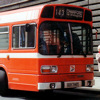
A new version of Service 143 was introduced by Midland Red Omnibus Company Limited (MROC) on Saturday 13th January 1979, as part of the new “SevernLink” MAP area scheme. The service was a short-working variation of Service 144, running over the same route between Birmingham and Marlbrook, then via Catshill and Sidemoor to Bromsgrove. The service then continued to the Charford area of Bromsgrove where it terminated.
Midland Red Omnibus Company Limited (MROC) ceased trading as a bus and coach operator at the end of services on Saturday 5th September 1981. The operations of Bromsgrove depot, and with it the operation of Service 143, passed to the newly formed Midland Red (West) Limited from the following day.
| 1 | 4 | 3 |
Timetable Archive
| January | 1981 | Birmingham ↔ Bromsgrove ↔ Charford |