Service W11: Service History
Page Content
Introduction
Service W11
On Friday 1st June 1928, the Birmingham and Midland Motor Omnibus Company Limited (BMMO—Midland “Red” Motor Services) commenced operation of a new network of local bus routes in the City of Worcester. This network replaced the electric tramway network that ceased operation on the previous day, and was introduced as part of the historic “Worcester Agreement”, in which BMMO oversaw and operated local bus routes in Worcester on behalf of the local authority.
The new Worcester bus network was the first of many area networks to be introduced by BMMO carrying a letter prefix on route numbers to denote the area, with Worcester route numbers having a “W”-prefix. To operate this new network, BMMO moved a fleet of approximately thirty new SOS “QL” buses to the city. The existing Worcester (East Street) depot could not accommodate all these, so a former factory in Padmore Street was acquired and converted for bus operation.
See Service W1 for a list of routes operated as part of the 1928 Worcester local bus network.
Service W11 (1928–1974)
Operated by Birmingham and Midland Motor Omnibus Company Limited
Service W11 was one of the original local Worcester City bus routes introduced by the Birmingham and Midland Motor Omnibus Company Limited (BMMO—Midland “Red” Motor Services) on Friday 1st June 1928, as part of the new bus network introduced to replaced the city's tram network.
The service initially ran between Worcester City Centre (The Cross) and Bransford Road, terminating at the junction with Boughton Avenue. This did not directly replace a tram service as none had operated on Bransford Road previously, but the section of the route between the City Centre and the junction of Malvern Road and Bransford Road was shared with the former Malvern Road tram route. Bransford Road had previously been, and continued to be, served by Service 417 that ran an occasional service between Worcester, Bransford, and Cradley, with certain journeys continuing to Ledbury and Hereford.
Buses ran an hourly service, seven days a week, between 07:53 and 22:54 on Monday to Saturday, and between 13:53 and 22:53 on Sunday. Other than minor changes to depart times, this remained unchanged until the Second World War when evening services were withdrawn, leaving the last departure from the City Centre at 19:53 each day (19:33 on Sunday). Evening journeys were reinstated after the war ended, but they didn't run as late as the pre-war service with the last departure from the City Centre being at 21:53.
By March 1947, the City Centre terminus had moved to Worcester (Angel Place) bus station. This probably happened soon after the opening of Worcester (Newport Street) bus station in July 1946, when long distance routes that previous departed from Angel Place were moved to the new site. With more available space at Angel Place, local routes that crossed the River Severn to St Johns were moved to Angel Place.
In 1948, the Service W11 route was extended to the nearby village of Rushwich, terminating at the junction with Bransford Road and Three Quarter Mile Lane, now called Claphill Lane. Adjustments were made to departure times to accommodate this change, but the frequency remained hourly with departures from Worcester between 07:29 and 21:29 on Monday to Saturday, or 10:29 and 21:29 on Sunday. By February 1949, an extra evening journey had been added to make the last departure from Worcester 22:29, seven days a week.
The route remained unchanged throughout the 1950s and 1960s, and other than a few minor adjustments, so did the timetable. Rushwick Halt railway station closed on Saturday 3rd April 1965, but it appears this did not prompt a change to Service W11, which continued to run once an hour throughout the day. The most notable timetable change came in 1968 when all the departure times from Angel Place moved forward to 10 minutes past each hour, with the last departure now at 22:10, except on Saturday which had an extra journey at 23:00.
The National Bus Company (NBC) was formed in 1969, and under government control there were significant cuts throughout the entire BMMO network during the 1970s, and Service W11 was one of the first victims with all Sunday journeys being withdrawn by October 1970. On Monday 3rd December 1973, BMMO sold a number of Birmingham depots and their operations to West Midlands Passenger Transport Executive (WMPTE). Following this, the company name changed to Midland Red Omnibus Company Limited (MROC) on Friday 29th March 1974.
Route Summary
- Jun 1928–Jul 1946
- Worcester (The Cross)
- St John's (Bull Ring)
- Bransford Road (Boughton Avenue)
- Jul 1946–Sep 1948
- Worcester (Angel Place)
- St John's (Bull Ring)
- Bransford Road (Boughton Avenue)
- Sep 1948–Mar 1974
- Worcester (Angel Place)
- St John's (Bull Ring)
- Bransford Road
- Rushwick (Three Quarter Mile Lane)
| W | 1 | 1 |
Timetable Archive
| March | 1972 | Worcester ↔ Rushwick |
Service W11 (1974–1976)
Operated by Midland Red Omnibus Company Limited
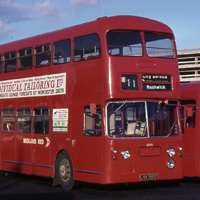
Under the new name of Midland Red Omnibus Company Limited (MROC), Service W11 between Worcester and Rushwick continued to operate over the same route until Friday 13th February 1976. On that date, at the end of the days trading all “W”-prefix routes in Worcester were withdrawn and replaced by a new local Worcester network starting from the following day, also using “W”-prefix route numbers. The new network was run exclusively with one-man operated Leyland National single-deck buses, replacing the BMMO-built single-deck and Daimler Fleetline double-deck buses that had previously been used.
New Service W56 was introduced as part of the new network to replace Service W11, and ran over exactly the same route with an hourly frequency. The Rushwick terminus was now shown as Grange Lane, but in reality the same bus stop shelter was being used and this was just a better description of the location. Evening journeys of Service W56 were extended to and from Warndon and Bath Road over the same route as Service W55, but timetables stated “through fares not available.”
On Saturday 13th January 1979, a number of routes that made up the local Worcester network were once again withdrawn and replaced from the following day by a new network of routes, this time as part of the new “Severnlink” MAP scheme. The new routes also used “W”-prefix route numbers, with the Worcester to Rushwich route becoming Service W25 at that time.
Route Summary
- Mar 1974–Feb 1976
- Worcester (Angel Place)
- St John's (Bull Ring)
- Bransford Road
- Rushwick (Three Quarter Mile Lane)