Service W9: Service History
Page Content
Service W9 (1928–1974)
Operated by Birmingham and Midland Motor Omnibus Company Limited
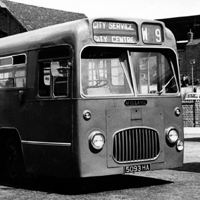
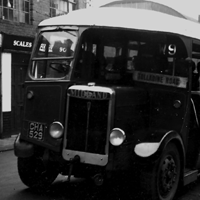
Service W9 was one of the original local Worcester City bus routes introduced by Birmingham and Midland Motor Omnibus Company Limited (BMMO—Midland “Red” Motor Services) on Friday 1st June 1928, as part of the new bus network introduced to replaced the city's tram network.
The service ran between Worcester City Centre (The Cross) and Tolladine Road, terminating at the Virgin Tavern. This did not directly replace a tram service as none had operated on Tolladine Road previously. With very little housing along Tolladine Road during this period, only four return journeys a day operated during the week, departing The Cross at 09:40, 11:40, 14:40, and 18:40. Journeys towards the City Centre departed the Virgin Tavern 10-minutes later. On Saturdays six return journeys operated, departing The Cross at 09:40, 12:40, 14:40, 17:40, 19:40, and 21:40. Buses also ran on Sundays, with four return journeys departing The Cross at 14:40, 16:40, 18:40, and 20:40.
By December 1930, an additional Monday to Friday journey at 12:35 had been added, plus a “Theatre Bus” on Mondays and Saturdays only, departing The Cross at 22:40. By 1946, the frequency had reached every 15-minutes in each direction, Monday to Saturday, or every 30-minutes on Sunday, and in 1961 this increased to every 12-minutes and 15-minutes, respectively.
With the building of new housing estates the service frequency increased and the route was also extended, first to the junction with Ambleside Drive (by May 1960), then to Windermere Drive terminating at the junction with Grisedale Drive (by October 1961), and later to Cranham Drive (c. 1966). Initially, the terminus in Cranham Drive was the junction with Sheepscombe Drive, but this later moved to the junction with Tetbury Drive.
The terminus in the City Centre also moved as the city's road and bus network evolved. First to St Nicholas Street (in June 1935), then Sansome Street (by October 1952), Queen Street (by May 1960), and finally to The Trinity (by May 1967).
By May 1967, new Service W39 had been introduced as an extension to the existing Service W9. The new service ran along the same route as Service W9 between the City Centre and Warndon, but then continued via Bilford Road and Droitwich Road back to the City Centre (High Street). Service W39 then continued as a cross-city route to Bath Road (Norton Turn) as a replacement to Service W10, along with Service W2 and Service W22 that were also extended to Bath Road. Service W9 and Service W39 were shown in timetables as a combined service with two departures an hour for each one, to give a 15-minute frequency on Tolladine Road and a 30-minute frequency on the Bilford Road to Bath Road section.
| W | 9 |
Timetable Archive
| December | 1930 | Worcester ↔ Tolladine | |
| March | 1972 | Worcester ↔ Warndon |
Service W9 (1974–1976)
Operated by Midland Red Omnibus Company Limited
On Monday 3rd December 1973, Birmingham and Midland Motor Omnibus Company Limited (BMMO—Midland “Red” Motor Services) sold a number of depots in the Birmingham area, and the operations of those depots, to the West Midlands Passenger Transport Executive (WMPTE). As a result of this, the company renamed to Midland Red Omnibus Company Limited (MROC) on Friday 29th March 1974.
Service W9 and Service W39 continued to operate over the same routes until the end of operations on Tuesday 13th January 1976, when they were withdrawn. They were replaced by a new group of routes numbered in the range W53–W57, which ran a circular route between the City Centre and Warndon, via Tollidine Road and Bilford Road, starting from or continuing to Bath Road or various St John's locations.